
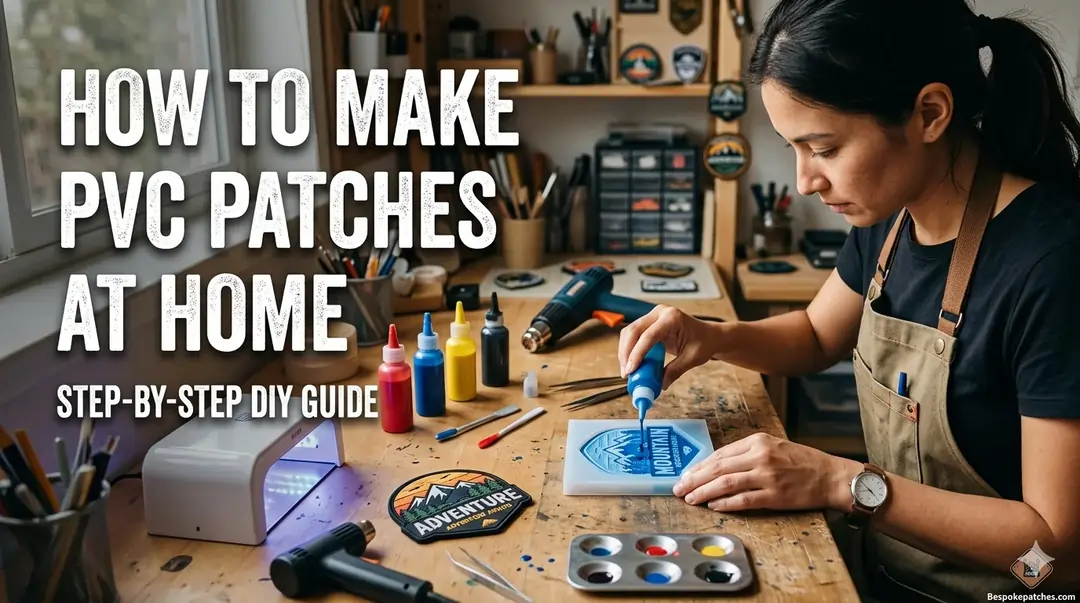
How to Make PVC Patches at Home | Step-By-Step DIY Guide
PVC patches have become increasingly popular among people engaged in creativity, hobby-making, or even small-business activities, as they offer durability and a level of uniqueness not found in regular fabric patches.
Recognizable by their rubber-like texture and bright colors, these patches are commonly used on backpacks, uniforms, coats, and military gear. The most distinctive thing about such patches is their ability to withstand water and wear and tear without losing their shape or detail.
Although many people think only large factories can produce these patches, that’s not true. With the proper supplies, one can easily make custom PVC patches at home.
What Are PVC Patches, and Why Make Them Yourself?
PVC patches are rubber-like, very flexible and durable, and come in bright colors. In contrast to fabric patches, PVC patches do not fray easily, fade easily, or absorb water, making them excellent choices for outdoor applications, clothing, etc.
Creating your own PVC patches means that you will be able to:
- Personalize any design you want, regardless of the minimum quantity
- Be creative with different colors and textures
- Spend less money in the long run
- Make truly unique custom patches
Materials You Will Need
Before beginning the process, gather the following materials:
- PVC liquid or rubber-based compound (craft quality)
- Silicone mould (either customized or purchased)
- Acrylic paint or powder (unless buying colored PVC)
- Plastic cups to mix the materials
- Syringes or squeeze bottles
- Protective gloves and work area covering
- Heat source (heat gun or oven, according to directions)
- Substrate (velcro, adhesion, fabric, etc.)
If a customized mould is unavailable, you may purchase or make one using a silicone mould kit. You can also ask a professional custom patch company for custom molds or hire the company to assist you in the project.
Step 1: Designing Your Patch
A good starting point is the design itself. Whether it’s a logo, a symbol, or any kind of artwork, your design needs to be simple so you can layer it.
Design tips:
- Use thick outlines and avoid using small elements
- Layer your design (every single color will need a separate pour)
- Use high-contrast colors so that they can be visible
- Make a stencil or vector from your artwork design
- You can either draw your artwork by hand or use graphic design software.
Step 2: Creating the Mould
Mould will determine how good your patch will look.
Option A: Buying Ready Mould
If this is your first attempt at patch-making, a ready-made mould will be more convenient.
Option B: Making Your Own Mould
- Lay out your design on any flat surface.
- Cover it with liquid silicon.
- Follow the directions provided with the product.
- Remove your design gently.
You’ll receive a negative imprint, which will serve as a base for pouring your PVC.
Step 3: Preparing the PVC Mixture
If the PVC compound is not pre-coloured, pigments will need to be mixed in.
- Pour some liquid PVC into the mixing container.
- Gradually add pigments till the required color is attained.
- Mix it slowly without introducing any air bubbles.
If several colors are required for a particular patch, individual colors should be prepared in advance.
Step 4: Filling the Mould
It is here that your design will be brought to fruition.
- Begin with the base layer (the color for your background).
- Fill the mould with your colors using a syringe or a squeeze bottle.
- Be sure to let the base layer settle first before adding more colors.
- Build your design layer by layer from bottom to top.
TIP: Proceed with patience to prevent any color overflow.
Step 5: Removing Air Bubbles
Air bubbles can ruin the smooth surface of your patch.
- Tap the mould gently against your workspace.
- Use a toothpick to burst any air bubbles that form.
- Let the mold sit briefly before curing.
This ensures a clean, professional look.
Step 6: Curing the Patch
The curing process will make your patch more durable.
- Follow the directions provided with the product
- Some need to be cured in an oven at low heat
- Others may cure at room temperature
If heat is needed:
- Put the mould into a preheated oven
- Be careful not to overheat it
- Let it cool down before removing
Step 7: Demoulding and Finishing Touches
When it is completely cured and cooled:
- Carefully remove it from the mold
- Cut off any excess material using scissors or a hobby knife
- Check for defects and fix them if necessary
At this point, the patch will be flexible and smooth to the touch.
Step 8: Adding a Backing
For your patch to be functional, you will have to add a backing.
Common Patch Backings:
- Hook-and-loop fastener: Useful for tactical equipment and military uniforms
- Adhesive backing: Simple for temporary applications
- Fabric backing that can be sewn on: Perfect for long-term application
The backing should be attached using a high-strength adhesive or embedded within the last curing process.
Creative Ideas to Try
After you have become adept at the basic techniques, try out:
- Glow-in-the-dark paint colors
- Translucent or transparent coatings
- Raised 3D images through stacking additional layers of PVC
- Metallic coatings
- Your own name tag or company logo
Your only limit is your imagination and what you choose to express through your custom PVC patches.
Common Mistakes to Avoid
Even though the process is straightforward, beginners often face these challenges:
- Excessive filling of the mould: This produces irregular borders.
- Rapid blending of colors: This creates muddled designs.
- Failure to pop bubbles: This results in an uneven surface.
- Improper curing temperature: This distorts the patch.
Remember to take your time when performing the steps.
Safety Tips to Keep In Mind
Some considerations need to be taken when working with PVC material:
- Always conduct activities in a well-ventilated room
- Wear protective gloves to prevent exposure
- Avoid breathing any fumes while heating
- Prevent access by children and animals
The benefits of safety include achieving optimal outcomes and an enjoyable crafting process.
Frequently Asked Questions
What materials are needed to create PVC patches at home?
To create PVC patches at home, you will need liquid PVC or rubber, silicone molds, pigments, mixing kits, and syringes used for pouring. Also, one might need additional supplies, such as a heat source (if necessary), special gloves, and the material on which the PVC patch should be attached (e.g., Velcro). It is important to have everything ready beforehand.
How expensive is it to create DIY PVC patches?
At first glance, PVC patch production seems rather expensive due to materials such as silicone molds and liquid PVC. But after getting the necessary equipment, the cost of producing each individual patch drops considerably compared to buying professional ones.
How similar are DIY PVC patches to professional ones?
DIY PVC patches are not inferior to professional ones in terms of quality, since both production methods use the same materials and tools. If no industrial machine is available, one’s own hands can produce an equally good patch.
What is the time required for making a PVC patch at home?
The process takes a few hours, depending on the complexity of patch creation and the drying period. Simple patches are made within 2 to 4 hours, but more complex, multi-layered patches require more time. The curing or drying phase is often the longest phase.
Can DIY PVC patches withstand water exposure and remain durable?
Certainly, DIY PVC patches are water-resistant and quite durable when created properly. They have greater resistance to water, fading, and damage than fabric patches.
Wrapping It Up
DIY PVC patches require artistic skills and expertise. This method enables one to develop professional PVC patch designs without necessarily relying on major manufacturers. Although the patches may not come out very well at first, each attempt will improve in quality and expertise. As your skills improve, your results will too, as long as you apply patience and creativity in your work. These patches are not only fun to make but also useful and practical for a variety of reasons.

I am the editorial voice behind the BespokePatches.com blog, where I explore the artistry, craftsmanship, and innovation behind premium custom patch production. My content highlights design precision, fabric selection, stitching techniques, and branding strategy to help businesses create patches that truly stand out. From embroidered and PVC to woven and chenille styles, I provide in-depth guidance on choosing the right materials and finishes. My goal is to show brands, clubs, and organizations how bespoke patches can elevate identity, strengthen recognition, and add lasting value to their merchandise and uniforms.